Tuesday, November 12, 2019

The Gardens Between


Imagine a game in which you can't actually control the characters you are playing - you can only move forwards and backwards in time to find out what they do and where they go.  Along the way, you may have the characters touch certain objects in order to subtly change the flow of time and enable them to progress along their pre-determined path.

This is the surreal and almost maddeningly passive world of The Gardens Between.

The feature that initially caught my attention as I was browsing the App Store was, as it often is for me, the beautiful and interesting graphics of the world within the game.  Each level is constructed of oversized objects of a child's play space, and encapsulates the imaginary world that the two children - a boy and a girl - spent together.  As they travel together in a treehouse in horizonless ocean, they move from island to island built with scenes such as a huge couch hidden by a blanket fort, giant dinosaur skeletons that break apart and tumble into the sea, and sewers draining into a whirlpool with log size soda cans swirling into it.  Each island progresses from gentle dawn, to rosy mid-day, to a terrifyingly dark storm world at the end as the worlds of child play begin to fall apart.  All this is portrayed without words or instructions, with a story that only opens up more questions until the very end.

Aesthetically, the game is unquestionably both visually stunning and unusual.  Although an incredible amount of detail is included in each of the scenes, with waving grass, paint splashes, etc., everything is somewhat pixelated with foggy edges, contributing to the dream-like atmosphere.  The children pause when the flow of time stops, their figures blurring in the frozen motion, but the island's breezes continue to blow and the streams of water continue to flow.  Flowers give off orbs of light that the little girl can collect in her lantern in order to progress through the level and finally solve it.  The little boy is able to touch chimes that can shift events or move a certain part of time backwards and forwards.  As each puzzle-island is solved, the scene turns into stars which collect in a constellation that forms the actual event that makes up the memory.  It's a unique and engaging method of game play that can be frustrating at times, but also very rewarding at the end.

Integrated seamlessly into this world are very subtle, similarly foggy sound-effects that often clue the player in to what is required in order to proceed in the game.  The characters' footsteps are gentle and crunchy, while the environment SFX are dedicated and understated with no reverb.  The overall effect is intimate and dream-like.

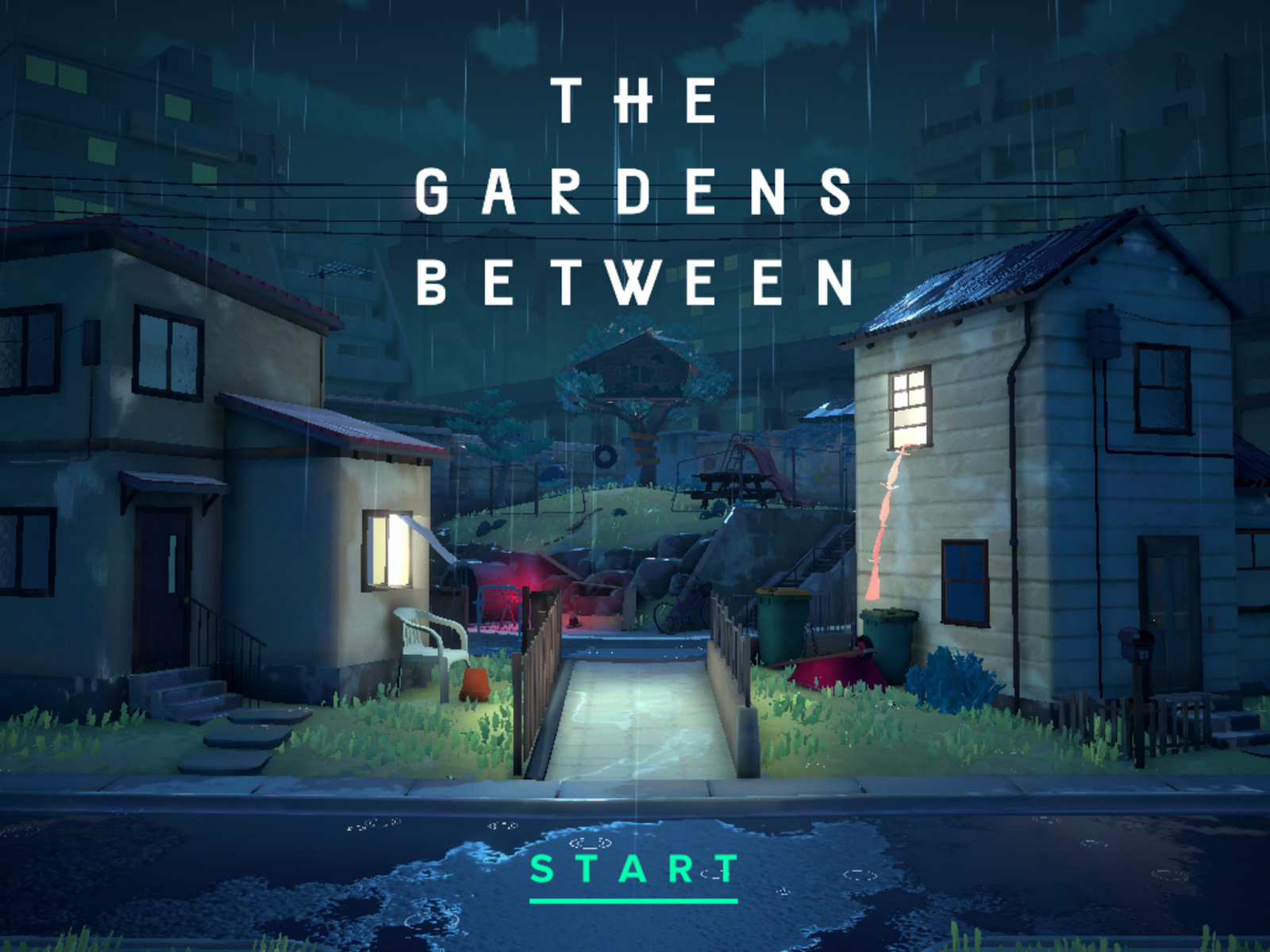
Likewise, the music is mostly atmospheric but contains layers of sound that seem to interact with each other and flow independently, resonating playfully.  Many of these layers seems to be built from the kinds of sounds that one would find at home - pots and pans, wind chimes, and of course a toy piano.  As the game progresses, the music changes from light and playful to dark and foreboding and, in the end, changes to dread as the characters send many levels of a dark, rainy cliff, finally emerging into a thunderstorm on top of the clouds, with reversed sound elements that imply the impending crumbling of their relations when the little boy moves away at the end of the game.  Interestingly, the opening screen of the game actually portends this moment of dread with its rainy scene.


Overall, I felt that the game is, like many of the "experience story" games I enjoy, beautiful and creative, with a somewhat simplistic gameplay.  It does become more intricate along the way, and the final scene, in the clouds among the lightning, has an exquisite amount of impact in the way the world crumbles and tumbles into pieces, with the sound effects of clattering stone kind of shocking and setting you up for the impact of the delivery of the final scene.  The music doesn't play much role in terms of story telling, but contributes to the overall atmospheric effect.

This game is definitely a unique and captivating experience, perfect for the casual player who wants to puzzle solve in different ways, with a simple but moving story that unwraps itself in unexplained ways.


Wednesday, August 21, 2019

2019 Hype Jam - A Game Trailer Jam

Hello!

This year marked the beginning of the annual Hype Jam - a game jam organized by Andrew McPherson and hosted by the Seattle Indies.  At this jam, game developers come together to create a trailer for a hypothetical game - in 48 hours!

This year, the event took place from August 2-4 at the beautiful Midtown 21 building in downtown Seattle.  The jam was sponsored by Amazon Game Tech, Amazon Games, and Twitch, and it included food for hungry game developers and outstanding aerial views of Seattle.

At the beginning of the jam, individuals conceptualized and presented ideas for a hypothetical game that could be created.  Groups formed around some of these ideas, with programmers, artists, sound developers, and storytellers teaming up together to make a trailer.

One young lady came with a fully developed story that seemed really engaging right off the bat.  I decided to join the team:

-Tessa Thurman (story development)
-Anabelle Decoret (editor)
-Erika McKracken (videographer)
-Bill Morse (character design/2-D artist)
-Grace Wallis (music and sound design)

Together, we worked to create a game trailer based around the story of someone who applies for a job...only to get blackmailed into becoming a gig-economy super spy.

I participated by recording voice-overs, designing the sound for the sets and sound effects, and, of course, preparing the entire music soundtrack.


You can view the completed video here on YouTube:


It was a lot of fun to put together with my teammates, and I look forward to repeating the adventure at next year's Hype Jam!

Thursday, August 8, 2019

Fiasco Recording Session

Hello!


For the past ten months, I have been working on my master's degree in Film Scoring at the Pacific Northwest Film Composing program https://www.pnwfilmmusic.com

This accounts for why there have been no blogs in many moons.  Fortunately, I survived the program and emerged with a degree, so here is a sample of what I've been up to.

The "Fiasco" recording session, as it is fondly known in the program, is the final project for the program.  The students are asked to write a two-three minute "end credits" sequence for a hypothetical film, for a 52 piece orchestra, and then conduct and record it live.

My piece was written for the hypothetical film "Orion", about the legendary Sumerian hunter (passed down to us in the form of the Greek constellation).  It begins with the heroic, sparkling theme of Orion, has a romantic section about his relationship with Artemis (goddess of the hunt), and the returns with a bang to the theme.

This video was recorded and compiled by SFI student Malcolm Frankson, and he did an awesome job.  The final version of the piece was mixed and mastered at Studio X.

Thanks for listening!

Sunday, October 7, 2018

Port Townsend Film Festival

Hello!

In September, I started my first quarter at the Pacific Northwest Film Scoring program under Dr. Hummie Mann.  For our first weekend, I and four other students in the program attended the Port Townsend Film Festival located in (obviously) Port Townsend, WA, on a peninsula west of downtown Seattle.  Our mission was to attend four films, two filmmaker panels, and a Q&A with film composer John Bayman, so it turned out to be packed weekend before returning for our next week of classes.

Port Townsend is a very "nostalgic" town that hosts many festivals throughout the year.  The main street, "Water Street", runs along the shores of the West Puget Sound, and contains various oddities shops, bookstores, and of course several theaters and museums that house the films that are screened throughout the various festivals.

Once a year, a film festival takes place here that features shorts and feature films submitted from around the world.    Documentaries and Narrative Documentaries are most prominent, with some dramas included.  In addition to the screenings, various panels are offered with discussions with the film makers, including the producers and writers.

Furthermore, my classmates and I were able to attend a Q&A with John Bayman, who scored an excellent 80-minute soundtrack for the 1926 silent film "Eye of the Totem", which is a story about Native Americans in Tacoma in the 1920's.  Sadly I was unable to attend the viewings, but we had an informative discussion about scoring films and the industry attached to it.

I watched four films over the weekend:

-Active Measures
-Don't Be Nice
-Of Dust and Bones
-The Drummer and the Keeper

In short, my responses are as follows:

Active Measures, directed by Jack Bryan, is a documentary about the Russian interference in the United State's 2016 presidential election.  It included backstory about the connections between the current administration's personal interests and the Russian KJB and their leader.  More interestingly, it added contextual information regarding Russian's interference with countries such as Georgia and Ukraine.  As this topic has become incredibly over-discussed due to omnipresent political news articles, I found the film to be wearying.  The score (written by...) was very appropriate, however, with ambient music that added to the tension without overstating emotions.

Don't Be Nice, directed by Max Powers, turned out to be my favorite movie of the festival.  It is a documentary about a group of Brooklyn poets who compete in "poetry slams", mainly highlighting African-American and queer perspectives and responses to the world's responses to their identities.  They are pushed by a dynamic coach/leader, Lauren Whitehead, who asks them to dig deep inside and expose their own vulnerabilities.  The score was minimalistic and soulful, with haunting, wordless vocals and plucked string sounds.  Ultimately the film ended up winning the "Audience Choice Best Narrative Feature".

Of Dust and Bones, directed by Diane Bell, takes place in Joshua Tree, California, a barren landscape to which a widow, Clio, has receded after the death of her husband in Syria.  His best friend comes to request the last remaining documentation that her husband took while in Syria, for publication.  The visuals were bleak and honestly appeared to rely too much on the wide land of the desert for interest, but the sound editing was quite good.  A similarly minimalistic score accompanied the film, but did not include enough background to make the film move faster or seem more interesting.

The Drummer and the Keeper, directed by Nick Kelly, was a film that I really would have liked to see win an award; unfortunately it did not.  However, I felt that the overall quality of the film, including acting, directing, plot, and cinematography, was theater film level, and could easily build an audience simply based on how interesting the film was.

There were several other films that I would have enjoyed seeing, but unfortunately there was not enough time to see them all, and often the tickets were all gone before we had the opportunity to get them!  Other films I hoped to see were:

-Soufra
-All the Wild Horses
-Sadie
-MadHattan
-Ayla: The Daughter of War

The festival had the feeling of a very energy-packed, see-it-or-miss-it opportunity, here in all its vibrance today, and tomorrow back to normal life.  I'd enjoy returning again next year to see new offerings from rising filmmakers.

Thanks very much, Port Townsend!

Saturday, September 1, 2018

Monument Valley review

When I think of video games that I truly enjoy, there are a few unifying elements in my preferences:

1. Beautiful art
2. Puzzle solving
3. Story telling
4. Unique, progressive music and sound design

Often it will be the art presentation that I see in the demos that makes me interested in playing the game.  I like pretty colors, tidy organization, and fantasy environments, and when I see a game that promises these things, I immediately want to try it out.

Of course, this is how Monument Valley, an indie game developed by the London based company ustwo, hooked me as soon as I saw it in the App Store.  Created for iOS devices, the game utilizes the touch screen for manipulating the environment on the screen and guiding the main character through the Escher-like mazes.  As soon as I saw the pretty pastel colors and satisfying game play, I thought "Oh, I have to play this game!"  And so I did.

So, a brief review of "Monument Valley".

As stated above, the art design is beautiful throughout the game.  With a design based on isometric geometry, all of the sets are comprised of uniform-sized blocks, with color gradation schemes varying from level to level, as if the structures are created from stones of a single quarry.  The background usually both contrasts and harmonizes with the structures.  Among the beauty of the pastels is the player-character Ida, in stark white against all of the colors.


One of the most intriguing and enjoyable aspects of the game is the Escher-like impossible objects, created mainly by rotating objects on the screen until they lock into place.  This is made possible through the aforementioned isometric geometry.  Although a pathway may look as if it will end at a certain point, if the screen is rotated, suddenly the block aligns with another block that previously appeared to be one or more units higher than the original.


Gameplay involves manipulating the structure by means of rotational devices, levers, buttons, wheels, exiting and entering doors, and a unique character known as the "Totem" which comes in very useful to Ida when she needs an extra surface to utilize.  Although you are exposed to the entire process of the structure moving according to your directions, the blocks will always lock into place with rather satisfying sound effects (more about that later).  Ida's goal in each scene is to return an platonic solid object to a platform.


Another entertaining aspect of the gameplay is that Ida and the other characters (including the Totem and the cute but obnoxious crows) are able to travel not only on the upper surfaces of each platform, but also on the sides, upside-down, and curves.  This perspective challenges the player to consider each arrangement in a different way, and also to measure Ida's progress based on different strategies.


My favorite level happens to be the "Puzzle Box", which starts with a simple box, but as you open it it reveals multiple rooms and platforms, with Ida traveling between them through doorways.  You had to open the other rooms to find out where she ended up afterwards!


Ultimately the puzzles in themselves are neither too challenging nor frustrating.  They are fairly easy to solve with common sense (or rather reconsideration of common sense) and a little bit of experimentation.  They are very relaxing and satisfying to solve.  Indeed, the only frustrating thing about the game was its short length; immediately after finishing the original release I found myself purchasing the expansion pack, and subsequently Monument Valley 2.


The music, following the theme of the game itself, is exceptionally minimalistic, based on open octaves and perfect fifths with pure synth sounds that kind of float around like the unanchored structures.  Each scene features a different theme, and interweaves perfectly with the sound effects.  Since the music stays within the mid-range frequencies, any significant move in the game (such as discovering a new way in which the structure can be manipulated or revealing a new level or door) will result in a chord which expands both up and down an octave or two, giving a satisfying swell which then dissipates as the character continues the journey.


In addition, each manipulative device, when utilized, has its own characteristic sound effect, such as harp or marimba sounds, which harmonize with the score itself and are always consistent with the position of the blocks on the screen.  This becomes very entertaining when other characters (in particular the Crow People) are independently triggering events by walking over them on the screen, resulting in a symphony of sound effects like a musical score, yet completely randomized.


The music is always symbolic and appropriate, adding to the atmosphere whether it be colorful or somber.  It seamlessly integrates into the surrounding graphics and story.


Overall, I would say I loved this game, and would play it again along with any future installments to the franchise.  If you want a relaxing, beautiful game with a minimalist plot, this is a good game to play.

Gameplay: 9/10
Art: 10/10
Music: 9/10
Story: 8/10
Overall: 9/10


Tuesday, August 21, 2018

Doki Doki Literature Club! Review

Hello!  From today, I will start writing reviews of video games that I have been playing, especially regarding their soundtracks.

Today's game is the infamous: Doki Doki Literature Club!

WARNING:  Spoilers

Created by entirely by Dan Salvato, who described it as a reaction to his love-hate relationship with anime, this game has earned a cult following and reputation for its distinct deconstructionist vibe, since it sets up a standard hentai harem visual novel plot and then systematically dismantles it.

The feeling is very similar to the ending of 2001: A Space Odyssey, in that it causes you to question the invisible wall between fiction and reality, and reconsider expectations and how they are (or aren't) fulfilled.  The main difference, however, is that within a game environment, you are directly connected to the decisions and consequences of the main character, and so your control over the situation (or lack thereof) has a more direct impact on how you relate and react to the story.

So it sets up the story in the standard way: You're (assumably) a standard male high school student with a cute female friend (Sayori) who invites you to join her after-school literature club, which consists of three incredibly cute girls (Yuri, Natsuki and Monika) with standard personalities: genki girl, goth girl, and perfect class leader.  By writing "poetry" and sharing it with each member, you shape the plot to determine which girl you will get in the end.  Honestly, for the first hour or so I was pretty bored, since you are actually supposed to discuss the poetry with them for what seems like an eternity of fluffy conversations.


But then, of course, things start to unravel a bit.

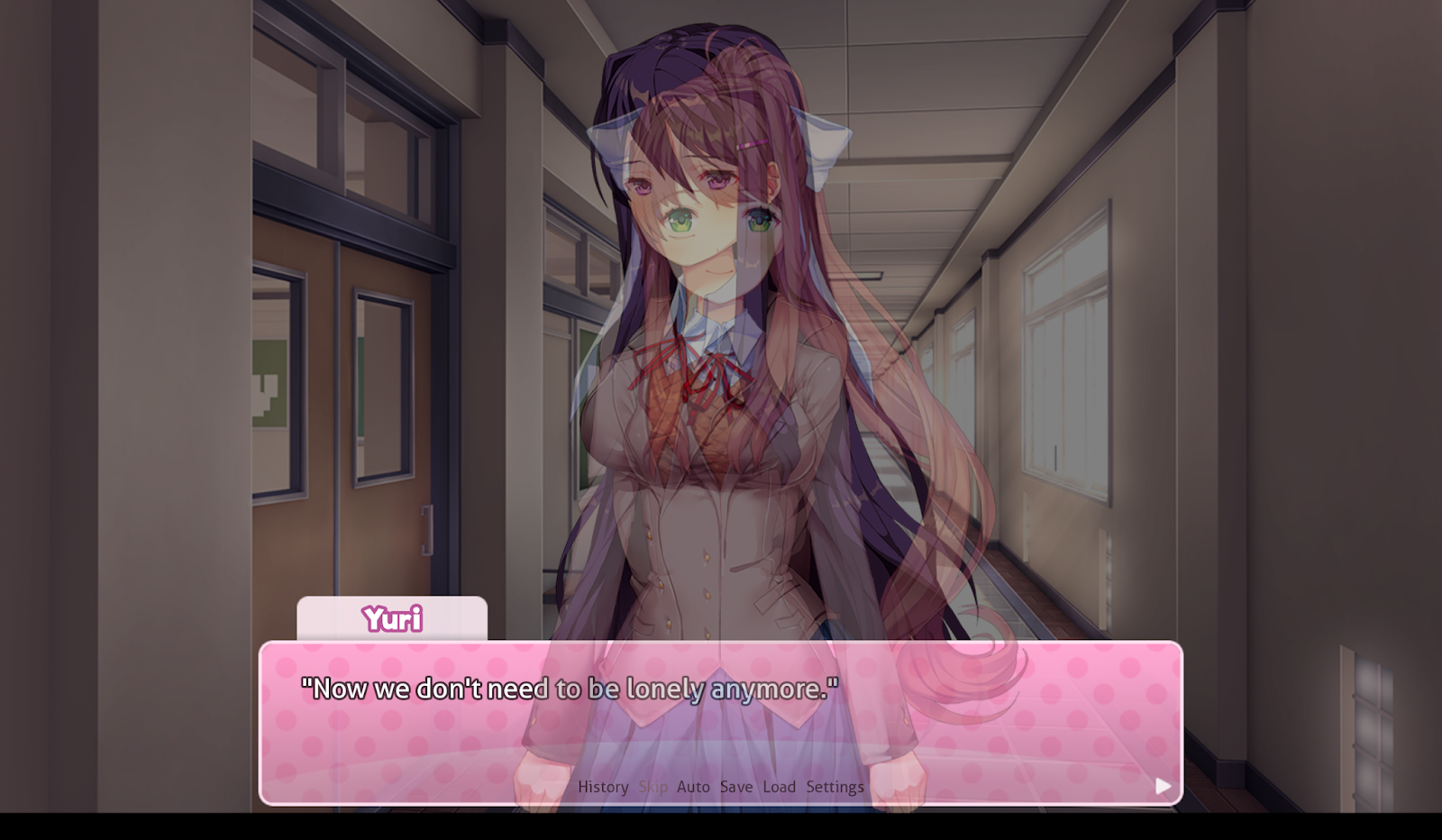
First, you find out that Sayori is suffering from depression.  In an attempt to comfort her, you can decide whether or not to tell her you love her...or whether you will always see her as your best friend.  Unfortunately, whichever choice you pick will result in this:


So not so fluffy anymore.

But don't worry!  Monika has figured out how to make the game all better.  She decides to erase Sayori's existence in the game, including any reference to her and any save points you had in the game already, and then the game restarts without Sayori.  If her absence in the story is notable, the screen will glitch and text is replaced with unreadable script.  Okay, but now you have to go through all the maddeningly non-ending poetry discussions...again.

Well, the second time around starts changing up a bit, though.  First of all, it seems that Natsuki and Yuri have started a bitter feud, which becomes so intense at one point that Monika intervenes and erases the entire section so you don't have to deal with it.  Also, you walk in on Yuri, who is already pretty goth as it is, actually cutting her wrists - this disturbing image fades into a superimposed image of Monika, as she again erases the image.


At this point, art, plot, text and music are slowly eroding.  The screen starts to shift and glitch, text appears in hyper-bold script, and you get screens where you are either presented with a choice where you only have one choice ("Just Monika"), or you're given a screen with just "Yes" and "No" on it.


Ultimately Yuri ends up stabbing herself to death after confessing her love to you, and Natsuki vomits when she sees the corpse and runs away.  Monika ends up intervening by erasing these two girls...

...And takes you to a dimension wherein she destroys the fourth wall, starts talking to you as the player not the character, about how much she's always wanted to spend time with you but the other girls got all the attention, etc, so she had to make them so unlikeable in the game that you would abandon them.  She also goes into a diatribe about the "uncanny valley" - about how if something is just so slightly off, it is much creepier than if it was completely different from how you expect (game self-reflection).  She tells you how easy it was to erase their data and then proceeds to give you exact instructions on how to do so (pay attention!).  After that she says she just wants to stare at you for a long time...


And proceeds to do so, without giving you any way to click out of the screen.  If you try to save the game, she tells you "Don't worry, I'm not going anywhere!"

CREEPY.

So if you've been paying attention at this point, you should know how to go into the game files and erase Monika.  Then you can restart the game again with all of the other three girls, but no Monika.  Eventually, Sayori ends up confessing to the main character that she wants him/her all to herself, and Monika intervenes once more, thus ending the game entirely.


Okay, so that's the gist of the game play itself.  Honestly it was more psychologically disturbing than any number of zombie games I've seen.  Even though some aspects of it are fairly obvious to anyone who has studied deconstruction theory, the fact that you are an actor, not just an observer, ties you into the plot more deeply and creates more investment in the story.

Onto the music.

In addition to writing and producing Doki Doki Literature Club!, Dan Salvato also composed the soundtrack.  It is fairly upbeat and minimalist with standard synthesized string, guitar, glockenspiel, and drum tracks, and the typical I IV V I chord progression.  Especially at the beginning, it fits right in with the visual novel soundtrack, which can bear endless repetitions but perhaps purposefully gets very tiring after awhile.  There are separate tracks for various activities and settings, such poetry reading, cupcake making, etc.

Although honestly the melodic and harmonic construction is pretty much deafeningly dull, the synthesized orchestration and balance is fairly well done.  There were times when I wanted to rip my headphones out and fling them across the room, but possibly that was the point.

As the story itself becomes darker and the screens start to glitch, the music also follows suit, beginning with a more somber tone as Sayori explains her depression to you and cries in your arms.  While still standard and with a painfully tonal harmonic structure, it at least portends the darker tone to come.

After Sayori hangs herself, the familiar welcome screen music starts to distort, with the pitch wavering and bending, and the instrument selection becoming more minimalist with single-hand piano, glockenspiel, and obviously synthesized vocal "Ahhh..."s.  When Monika erases her data and restarts the game, the music reverts back to the original songs, but as events start to trigger glitches in the game, the music itself also starts to glitch, including the following elements:

-"broken record" effect
-bit crusher
-intermittent white noise
-rewind effect
-equalizer and reverb

Monika's final two songs, when she takes you out of the game dimension into an uncanny valley reality, are exceptionally atonally minimalist, and utilize more SFX synthesized sounds.

At first I was unimpressed with the soundtrack.  It rarely has any interesting harmonic progressions, and the instrumental choices are all sounds easy to create and use synthetically.  However, upon viewing this video my opinion changed.  There was a lot more consideration that went into the music elements than I originally realized while playing the game, mostly regarding how the creepy elements were created and used.

While I deeply enjoyed the deconstructionist perspective on this genre, the game did so in a very simplistic way overall.  There are very few choices for the player to make.  It relied almost entirely on breaking the fourth wall for its impact, and the art, sound and story were left lacking in interest as a result.  The game is a statement, an interactive film perhaps, and while I enjoyed the experience the first time, I wouldn't play it again.  It's worth a recommendation for people who can appreciate deconstructionist theory.

Gameplay: 3/10
Art: 6/10
Music: 9/10
Story: 8/10
Overall: 7/10

Tuesday, July 24, 2018

Seattle 48 Hour Film Project - Team Shenanigans


From July 13-15, 2018, I had the honor of working with Michelle Shadday's "Team Shenanigans" (originally Team Estrogen), for the third time.  

The 48-Hour Film Project is a nation-wide festival in which teams of amateur film-makers write, film, and edit an entire 4-7 minute movie for submission - all within a single weekend.  Not only is it a great experience with your friends and a lot of fun to put together, it is also a good opportunity to push yourself to complete a project and have a finished product.  Afterwards, all teams who completed their projects participate in a film-screening at SIFF Uptown (for Seattle teams).

On Friday evening, each team pulls their category from a hat, and all teams receive items that the film must include:  1) a name and occupation of a character,  2) an object, and  3) a line of dialogue.  The writers begin on the script as soon as possible, and (typically) by the next morning, the crew begins filming.  Post production includes editing, sound effects, and music.  By Sunday at 7:30pm sharp, all films must be submitted or they are out of the running.

Our team this year consisted of:

-Michelle Shadday (producer/actor)
-Sandra Geldenhuys-Scragg (director)
-Bilal Young (associate director)
-Chen Yu Hsu (associate photographer)
-Nicole Pouchet Skuba (screen writer)
-Christopher Chambers (actor/editor)
-Yvonne Velez (actor/editor)
-Natasha Clarette (actor)
-Colleen Kelly (makeup)

We unfortunately lost both our director of photography and editor shortly before the festival began, and thus several members of the cast had to step in to fill their shoes.  This resulted in a rougher process than usual, and a true "48-Hour" experience for Chris and Yvonne, who both acted and edited.  

Our category for the film was "Romance", which turned into a romantic comedy called "Speed Date".  Nicole wrote a cute, punchy script depicting a rather ill-attended speed-dating event with two women and one man.  Humorously, it is the two women who develop chemistry with each other, and leave the sole man alone with a glass of wine at the end.

As the composer for the score, I found a new challenge with this film.  Since the script was essentially one long scene and dialogue sequence, I couldn't just write individual pieces of music.  Nor could I write one long piece of music, because I wouldn't have the opportunity to view the movie until after it had already been submitted.  I could only approximate the necessary material based on the script, and give it to the editors to add pieces in as they put the film together.

I attempted to solve this problem by creating a puzzle-piece score.  I created several themes that could be looped, truncated, fit together, or layered in any number of combinations, hopefully without losing the interest of the audience:  

1. Pizzicato string quartet intro

2. Bassoon addition (character theme)

3. Light percussion track (dates)

4. Pizzicato + percussion track

I made sure that each of these pieces had identical tempi, filters, reverb, and complementary instrumentation.  In addition, I created two "romance" tracks that were meant to warm up the romantic moments of the film and add an extra layer of cheese.  Finally, I created several short moments which could be used to punctuate the sillier actions in the film.

After finishing the film, I created a suite from these pieces for a full soundtrack:
(photograph taken by Chen Yu Hsu)

For more information on the 48 Hour Film Project, see the festival's website below:

Friday, July 13, 2018

Brahms v. Radiohead at the Seattle Symphony


On July 11, I went into a concert with the slight trepidation of having no idea what I was getting myself into.  The program was a conglomeration of two famously complex and wildly different artists:  Johannes Brahms, and Radiohead.

The brain-child of conductor/composer Steve Hackman, "Brahms v. Radiohead" is the complete integration of various songs from Radiohead's 1997 album OK Computer into Brahms' 1st Symphony, which happens to be my favorite symphony of all time.  Mr. Hackman seemingly does it all:  according to the SSO program I was holding, he is not only a conductor and composer, but also a singer, pianist, producer, DJ, arranger, songwriter "and even rapper".  Considering his breadth of expertise, it seems natural that he would begin to innovate various ways of combining the classical repertoire with popular music.

As I entered the hall, with nose-bleed tickets in the right corner of the third tier, there seemed to be an even mix of both younger and older generations.  This is common with the exciting new concerts that introduce popular music as played by the orchestra, and is, in my opinion, an extremely positive indicator of the continuing success of the symphony.  I also noticed that, somewhat more uncommonly, the entire hall was completely full, even up in the nosebleeds.  

This is apparently what you get when you showcase two superstars from different spheres of the music world.  

Joining the orchestra on stage were three vocalists:  Andrew Lipke, Bill Prokopow and Kéren Tayar.  Almost immediately, Lipke launched in with Radiohead's "Airbag", with a clear, carrying tenor voice.  

Without missing a beat, the orchestra transitioned from "Airbag" straight into the Brahms' 1st movement, not an easy task considering that the symphony begins with a thundering timpani heart-beat and long, dramatic chords from the strings.  My ears instantly adjusted to the symphony I have by now memorized.

After the exposition, they transitioned into "Paranoid Android", which was a bit jarring to me as my expectations of the natural progression of the 1st movement were suddenly interrupted.  It took a minute for me to say to myself, "Wait a moment, drop your addiction to the familiar.  Open up, consider the possibilities."  Once I made this mental shift, it became much easier to appreciate the painstakingly crafted blend of Brahms into Radiohead, and vice versa.

Ending movement 1 of the symphony was a transition into "Subterranean Homesick Alien", with Tayar's haunting, keening vocals, and a sudden breakout into three-part harmony of all three vocalists which raised the hairs on the back of my neck.  The song instantly became one of my favorites.

As the music progressed, the songs became more and more part of the actual symphony, with harmonies carefully constructed to fit the existing harmonies of the symphony.  I found this especially impressive since, as since I mentioned before, both of these works of music are incredibly complex.  Whereas many of the earlier classical (Haydn, Mozart) symphonies maintain standard chord progressions such as I-IV-V-I at regular beats in the music, Brahms is anything but regular.  His seamless transition from tonal center to tonal center and definitive shifts from triple meter to double meter and back stretch the bounds of tonal classical music.  Similarly, Radiohead utilizes modality, chromaticism, and other hyper-tonal techniques in their arrangements.  To marry the two is a beautiful accomplishment.

For example, my favorite Radiohead song turned out to be "Exit Music (For A Film)", in the middle of which it became apparent that the music was going in a completely different harmonic direction from the section of Movement IV which was playing simultaneously.  The tension created by the impending harmonic crash condensed into one terrifying moment where no one knew what would happen.  Suddenly, all three singers broke out into three perfect tones of an even diminished chord which had me astounded with the accuracy of the dissonant harmony.  

In less tense moments, the singers utilized satisfying suspensions, not only against the orchestra, but also against each other.  Somehow, everything resolved correctly.

Another part of the genius of Hackman's arrangement was inserting various motifs from the Brahms into the Radiohead songs.  A couple of instances of this technique stood out to me in particular.

First, anyone familiar with the Brahms' symphony will recognize the violin solo played towards the end of the 2nd movement.  Not content with letting this gem remain embedded in the classical world, Hackman gave it another prominent statement in, ironically, "No Surprises".  The reminder of the movement, now passed, was a particularly contemplative moment.

Second, in the last song of the night, "Electioneering", the famed horn solo from the 4th movement of the symphony interjected - in minor!  The cleverness of this moment was extremely satisfying for those in the audience who recognized what was going on.

Which leads me to my question of the evening:  The concert was clearly enjoyable for any classical music lover who knows the intricate inner working of a musical composition - the harmonies, melodic and motivic development, structure and orchestration.  But what of the audience mainly familiar with the Radiohead pieces?  Were they able to appreciate the concert to the same capacity?

My question seemed to answer itself with the final, bombastic brass chords of the symphony's fourth movements.  The entire packed hall immediately raised to their feet and started applauding as loudly as possible.  The singers left the stage and re-entered; as Lipke bowed, everyone started screaming as if they were at a rock concert.  Hackman entered; the screams got even louder.  By the time he acknowledged the orchestra behind him, the audience was going crazy, and kept it up for a good five minutes.

With this level of craft, consideration, and attention to details, along with stellar orchestration, it seems impossible that anyone could turn their nose up at the "pop music" that had sold out the symphony.  The integration of classical and popular ended up a wild success that did not sacrifice musicality and artistry.  

After all, according to Steve Hackman: "Ultimately, when you distill them, they are made of the same twelve notes."


Thursday, May 31, 2018

Chopin Nocturne

I've started a project recently for my beautiful little niece, Amelia.  Her mom (my sister), asked me to record some classical piano solos for Mila to listen to.

Here's the first recording, Chopin's Nocturne in E flat Major.  Incidentally, this piece was the favorite of my late grandfather, Dick Sauble.


Sunday, February 25, 2018

Island

About two years ago, my friend Michelle Martinez and I took a day trip up to a beach in north Seattle, and had long deep conversations about love, relationships, and culture.  Somewhere along the beach, we got around to discussing writing songs together.

Later on that day, high on sunshine and Indian food, we took a look at a piece that I was working on, "Theme and Variations", of which I already completed the first variation and intended to write three more.  Using the pre-existing melody as counterpoint, and the harmonic structure with some changes to the form, we started to add a vocal melody with original lyrics.

It was amazing how quickly everything came together, once we started on the idea of telling the story about her past relationship with a woman who was distant and controlling, like an island surrounded by fast currents.  The music happened just as fast, and we completed the piece in less than two hours.

Putting it together afterwards turned out to be more difficult.  I had only just started learning how to mix and master recordings in Logic Pro X, and Michelle was just starting out learning recording techniques.  We experimented with different microphones, changing the key, and adding compression, but ultimately I was never completely satisfied with the final product.

About a month ago, Michelle suggested that we take another look at it, try re-recording and mixing the piece.  This time, everything came together pretty easily, and finally I'm proud to present what we created together.


Thursday, January 25, 2018

Hub New Music

In a small, brick room resembling a vault in Seattle's lost corners of Capitol Hill, I joined an audience of maybe 15 persons for a performance of new music by mixed ensemble "Hub New Music".  As part of "Spontaneous Combustion"s mid-winter 3-week program, the group was invited with Michael Avitabile on flute, Jesse Christensen on Cello, David Dziardziel on Clarinet, and Zenas Hsu on violin.    It was a very intimate venue in an almost dead-space, where each instrument could be heard quite clearly.

The first piece, David Drexler's "Forgotten at Dawn", a score selected for the Spontaneous Combustion last year's call for scores, made good use of various string & cello techniques, with clear battuto col legion and on-bridge playing blended with the other instruments which swapped unison notes for a "who's got it this time" effect.  The Ensemble came together with a hollow balance, strings complementing winds and vice versa, with players who have been playing together long enough to resonate as a cohesive whole.

The second set, by Northwest composer Laura Kaminsky, depicted scenes from the Colorado Rocky Mountains, punctuated by the interruption of 9/11, which colored the set for the composer mid-through conception.  While there were some nice effects, I found myself disagreeing with the composer's endings; namely, that she either ended a piece of the set before I felt the development reached its peek, or adding a snippet where I felt the ending would be more effective.  For example, "Slate Riverbed" finished with a wholesome partnership of cello and clarinet, but where the mood and timing of clarinet would have been a satisfying ending, the composer chose to add a couple of extra notes in the cello that felt tacked on.  Furthermore, while "Boulders/Avalanche" had a very effective, tumbling beginning with gritty cello arpeggios, it recapped this thematic element near the end with none of satisfaction, nor even conclusion.  While I respect the composition and its method, I could not fully agree with its all the elements of its execution.

Robert Honstein's "Soul House", while drawing from a hum-drum programmatic subject, had some very satisfying and melodic pieces in the set.  For a world premiere of only 15 people in attendance, I thought it deserved a bigger audience.  Indeed, the conclusion of the first, "Bay Window", with its violin and cello harmonic arpeggios in varying speeds, drew goosebumps from my arms.  "Stairs" consisted of rising scales and major thirds for a whole tone series, bouncing, which was fun and creative.  I disagreed with "Alcove", with its static unison and pizzicato, which I felt lead nowhere, but my friend Jacob actually preferred this piece over the others.  "Hallway" was very loud and noisy - perhaps too much so for the small, dead interior.  I felt similarly about rising and falling "Driveway, which seemed to have little purpose though it had more motion than the former.  "Landing" felt like a technical study more than anything else.

"Cooper Beach", on the other hand, with a lovely 3rd ostinato passed from violin to flute to clarinet, had much harmonic purpose, with full but not cliche chords which pulled towards a goal.  The final piece, "Secret Place", started with a rising melody similar to "Ave Maria", and proceeded in a very carol-is set of unwinding chords.  While I agreed with the fluid harmonics, which kept returning to the melodic center, I cringed at the end.  As the violin rose in the melody to the highest pitch-perfect notes of the register, I felt deeply that it needed to decline in pitch to balance the obvious harmonics of the rest of the piece.  Unfortunately, it merely continued to rise to a conclusive tonic at the very top of the range of the violin, which felt so cliche that I thought it was a pity.

I wish "Hub New Music" all the best, and I hope to see them come to Seattle again in the future.

Thursday, December 21, 2017

Recording 11/28/17

In October and November, I was asked to compose an original soundtrack for David Fowler's 40-minute movie "Lean On Me".  Eight of the tracks were programmed into MIDI in Logic Pro X; however, I chose two especially sensitive pieces to be recorded by soprano Achil Obenza, and cellist Ash.

We recorded together at Jack Straw Productions ( http://www.jackstraw.org ) in the University District in Seattle on November 28th.  It was a bit of a challenge, since due to Achil's illness and Ash's surgery immediately preceding the recording session, none of us had been able to rehearse together except by sending one another recordings of us playing our solo parts for the other to practice to.  Nonetheless, both of them were troopers, and we managed to get some really beautiful recordings.

Below are "Darryl" (track 6) and "Good Friend" (track 7).


Thursday, September 7, 2017

Soundscape

Tonight, I had an existential crisis.

I think every artist has to go through these on a regular basis.

Somehow this happened as a result, and I won't lie, I'm rather proud of it.


Tuesday, September 5, 2017

Your Ma Must Be Proud 2017

In March, I had the privilege to debut two original compositions at the "Your Ma Must Be Proud" event, hosted by the Seattle Symphony Ushers.

My friend Janice Robinette, who wrote the poem "Bloodstones", asked me to write accompanying piano music for the poem.  In addition, I debuted "Theme Variation Number 3", which was recorded last year.

Here is the full program below:


Sunday, August 27, 2017

48 Hour Film Festival 2017

In July, I had the privilege of participating in the 48 Hour Film Festival, as part of Team Estrogen.

As the name may suggest, the team was comprised entirely of women.  In addition to producers Michelle Shadday and Amanda Drewniak, our writer/director was the talented Christina Perry, our photographer was Erica Stauffer, and our editor was Whitney Bennett.  Actresses Yvonne Velez, Elyse Kleidon and Sunga Rose filled out the ranks.

We wrote, filmed and edited the entire 7-minute move on site at Sandra Geldenhuys-Scragg's beautiful residence in West Seattle, overlooking the Sound and Mount Rainier.

Below is the fruit of our labor, a fun 48 hour adventure in film making.


Monday, January 2, 2017

The Four Seasons at the Seattle Symphony

There are a few pieces of classical music which are, unfortunately, so overplayed as to become jokes to roll one's eyes at.  For example, part of the reason why I still struggle with Beethoven is because everyone knows Für Elise, the Moonlight Sonata (movement 1), and his illustrious Ninth Symphony (choral section of fourth movement).  I have become increasingly sick of them, if for no other reason than because every amateur on the face of the planet will attempt, to a greater or more likely lesser degree of success, to play (read: butcher) select fragments of these pieces.

Notice how the 'Hammerklavier' never caught on, by the way.

Another reason why some pieces become nauseating to me is because they are used freely to caricature or conjure the atmosphere of a particular situation or time period.  Vivaldi's 'Four Seasons' for strings is a classic example of creating a courtly essence for anywhere from the 17th to the 19th centuries.  Aside from the point that clearly Vivaldi didn't live for 300 years, the sheer proliferation of uses of this set of works has trained me to quickly tune out.  This is a shame, because the four sets are strikingly original and exquisitely constructed.  It has been, in fact, more than a decade since I last purposefully listened to any of it.

So my presence at the Seattle Symphony's 'Four Seasons' program on the evening of December 29th was more of a fluke than anything else: I accepted a free ticket from a friend, and I have to admit that this was the first concert in quite a while that I have enjoyed from beginning to end - one that inspired me, filled me with wonder, and had me on the edge of my seat the entire time.

Vivaldi's work in this program is interspersed with another set of "Four Seasons" by 20th century Argentine composer Astor Piazzola, written as a set of four tangos, more or less actually danceable. In addition to providing the relief necessary for a full set of Vivaldi, this arrangement allows the soloists to rest and give their best performance, while directing the attention of the audience back and forth between a crisp aural experience and a sultry visual experience.

The first section, "Spring" of the Vivaldi began with a petite young woman on the solo violin, backed up with a compact string orchestra of classical dimensions.  As soon as she started to play, my thoughts were "This is so fresh!" and "Her baroque is just sublime."  With fluid bowing and flawless technique, crystal clear straight tones and brilliant, appropriately placed trills, combined with the energy of youth, I thought to myself that surely this young woman was channeling the spirit of young Hillary Hahn.

As the section ended, my companion turned to me and made some comment about "Simone Porter".  I did a double-take, scoured the program.  "That's Simone Porter?!"  Indeed, while I have heard of this rising star, I hadn't yet heard the real article.  And I still had three more sections of the Vivaldi to enjoy.

Piazolla's tango set began with "Summer", with SSO's Elisa Barston on solo violin.  She began to play a twisted dance, glimpses of the Vivaldi creeping in to comic effect.  In a few minutes, it became obvious that this performance wasn't going to be left to the instrumentalists alone.  With dramatic lighting from hard right and left, creating dark profiles, two dancers strode onto stage and began a typical Argentine tango.  It did not remain "typical" for long - as the music dictated, their dance became more and more flamboyant, with strong ballet influence demonstrated in the full jeté lifts and delicate arm placements of the female dancer.  

Thus set the stage, so to speak.  The remaining sections of the program unlaced the stays of the first two, opening up into more profound musicality, more sensual dance, going from the conventional to the abstract, step by step.  

With Vivaldi's "Summer", the Presto section opens into dizzyingly fast string crossing demanded of the soloist, and just as fast tremolos of the rest of the strings, to signify the onset of a summer storm.  Piazolla's answer with "Autumn" begins with the soloist bowing behind the bridge, evoking eerie screeches.  As the violin and the first cello intertwined their notes, the dancers began to intertwine themselves, with the male throwing his partner across the floor on her back, then coming down over her supine body in a passionate display of sensuality.  Lest the audience become altogether too uncomfortable, the section closed out the first half of the program.

After intermission and possibly cold showers backstage, Vivaldi's stately "Autumn" began.  The second movement was to me the most impressive of any in the program, with its sheer lack of virtuosity.  The low strings began in a sibilant murmur, building as the other sections joined in an unearthly groan.  (Here, I must complain, the harpsichord joined in with its usual lack of dynamic tact and rather spoiled the effect).  In full measures, gently evolving harmonies and evanescent top melodies from the soloists unwound note by note.  The third movement, by contrast, opened into a fun dance, punctuated with a short and heartbreaking B section as solo violin and cello again embraced each other's voices.

Piazolla's naked "Winter" section followed - easily the most melodically conventional of all four movements.  The dancers came in barefoot, no longer quite tango-ing, with bold modern dance evoking the desperation to leave and the necessity to stay.  Tension unwound in a very different way in this movement, as Ms. Barston dove into an impossibly long series of double-bowed intervals.

Naturally Vivaldi's vivid "Winter" followed, with its tell-tale fiery eight-note motive in all strings beginning unison and then unfolding into a chase.  I was struck for the first time by how much this section foreshadows 20th century harmony and techniques.  No longer wed to the rules of 18th century harmony, Vivaldi's full mastery of the strings is unveiled here.  Its minimalist short-bowing and atonality proved there was no need for 200 more years to play out before these techniques could be explored.  In a rather uncharacteristic tone, the third movement of "Winter" ends in a dark minor.

Finally, Piazolla's "Spring" introduces almost pure tango-style music, but the dancers, as they enter, seem to have little interest in such a dance.  Instead, they pick up a 30-foot length of virginal white gauzy fabric, tossing it in the air, wrapping themselves around it - evocative of flower petals or a veil?  Is it the beginning of a romance...or the ghost of love past?  It is left to the audience to decide.  

My final question at the end of the night was, "Who is the first cellist tonight?"  He shared some of the most exquisite moments with the leading ladies, pulling straining emotion into the darkest moments.  

Overall, this was the most balanced and best executed performance I've seen at Benaroya Hall in over a year.  The dancers were absolutely on-point.  All of the string players played as one.  The program was sensational.  I am eagerly looking forward to hearing more of Simone Porter's performances in the future.  

And best of all, perhaps, I do not dread Vivaldi so much as I did at the beginning of the evening.

Wednesday, December 14, 2016

Experiment 3

Here's a short study based on 8-bit "chip tune" music as introduced in '80s and early '90s video games.

This was another very quick composition created in two nights just because I've got nothing better to do.


Saturday, December 10, 2016

Theme Suite Variation no. 3

This afternoon, I invited my friend Janice Robinette, with whom I have collaborated on poem/piano music duos, to record her poem "The Faceless Doll", along with the third of my Theme Suite Variations (see below).

We recorded these two pieces at Audio Logic, Inc., in Seattle WA:  http://www.audiologicinc.com. The small recording studio is owned by Jay Kenney, but this afternoon we had an audio engineer named Justin help us record and master our pieces.

This third variation is based on the main themes from the original Theme Suite Variation piece I completed a couple of months ago.  Written for solo piano, it takes on the character of a fantasia, with developing themes in a loose form, easily moving from key to key.


Wednesday, September 14, 2016

In the Village Plaza

Here's a little piece I wrote in an hour... It's inspired by the "traveling music" background in early RPGs like Chrono Trigger, etc.


Synth Shit 3.2

Here's the last of my "Synth Shit" series for the time being.  In this one, I deliberately set up an atmosphere in which I could experiment with the parameters of synths in real time.

The Gardens Between

Imagine a game in which you can't actually control the characters you are playing - you can only move forwards and backwards in time...