Monday, May 4, 2015

[untitled] 3: May 1, 2015

Last Friday, as I entered Benaroya Hall for the show that night, the ushers said something I'd never heard them say before:

"Sure, go ahead and bring drinks into the auditorium.  Also, you can sit up on the stage if you get there early enough."

Well, I didn't take advantage of the new drink policy, feeling like it's absolute sacrilege no matter what anyone says, but I did head right for the stage and found myself engaged in a lovely conversation with two ladies soon after about modern music and who it was that invented twelve-tone.

This was only the start of an unprecedented program that symbolized, to me, the imminent changes that the Seattle Symphony Orchestra is implementing in its three-year innovative strategic plan.

Nowhere is the 'future' more evident than in its dynamic conductor, Ludovic Morlot.  In his introduction to the night's music, he told us that the [untitled] series, which encompasses quite a lot of modern music and only plays at 10:00 on Friday evenings, is his 'niche'.  It's an opportunity for him to introduce his devoted audience to the pieces that he loves, but doesn't really have the chance to present in the regular season programs.

His programming choices have been selling out houses; his collaborative interpretations with the orchestra leave his audience members stunned and rising in ovations afterwards.  Friday was no exception; by including a renowned pianist (Michael Brown) and introducing the Symphony's resident composer's newest site-specific work (Above, Below and In Between by Trimpin) with the intense vocals of Jessika Kenney, the house was completely sold out an hour before it started.

So first on the menu was a set of works by the late George Perle, all for ensemble, none (except the first, for string quartet) for conventional ensemble.  The second work, Critical Moments (No. 1), includes flue, clarinet, violin, cello, piano and percussion, utilizing a huge variety of effects for the strings, and a demanding entourage of instruments for the sole percussionist.  The third, Serenade 3, is a masked miniature piano concerto, with brass, strings, woodwinds and percussion in a five-part whirlwind.

My impression of Perle's work is complicated to express, because part-way through the first half of the concert, I realized what I now consider to be the purpose of modern music: not to internalize it and be able to sing it after, or even understand it; it's all about becoming immersed in the sensation of the moment, letting go of the tight grip on harmony, rhythm and form that drives most of the standard repertoire of classical music, and instead just giving into that very moment.  I think this is particularly true of the abstract variety of 20th century music, and for ensemble pieces, which allow room for voices to stand out and encourage the disparity of meaning.

In fact, the most accurate word I can think of to describe Above, Below and In Between is...immersive.  As we exited the hall into the grand lobby, we found that it had been transformed into the interactive experience hinted at by the piece's title.  The half-moon balcony was lit by masses of color; and music stands waited for the instrumentalists to join.  Hanging from the balcony was a series of large cylinders and pyramid-like blocks.  On ground level, which was covered with colorful mats for audience members to sit upon, an open grand piano was center stage, with a curious mechanical ensemble inside set to pluck and bang the strings across the soundboard, and play the keys themselves under the closed cover.

Morlot hastened to assure us that the black box with glaring red numbers inside the piano was 'not a time bomb'.  I assure you that's exactly what it looked like.


Above, Below and In Between is comprised of six movements, each showcasing the Frankenstein piano and introducing vocals and other instruments as well.  Not only did Morlot conduct the musicians, he conducted the piano as well; preset to play a certain work of music, he manually controlled the tempo and dynamics with his hands in thin air, like a theremin.  In essence, what Trimpin constructed is a method of controlling the interpretation of a mechanical work.

The first two movements consisted entirely of the piano; the third introduced Kenney, with her rich vocals that encompassed pure vowels moving through various diphthongs, bird-like gurgles and chatter, and mad-man cackles of laughter and enraged ejaculations.  In fact, her singing was possessed, and with her curly brown hair flying as she moved through the audience, one wondered if she was sane.  (I met her afterwards briefly, and found that her personality is very sweet, almost shy, her doe-like brown eyes deep and gentle).
For examples of her work, visit her website here.

The next movement consisted of the chimes ringing around the room, suspended and unstruck by visible hands; the fifth movement finally introduced the ensemble of instrumentalists, up on the balcony.  Coinciding with the nine pillars of the lobby, the nine instruments consisted of three trombones and  two each violas, cellos and basses.  Finally, Kenney rejoined the entire orchestra--piano, chimes, and ensemble--and escalated into a scream at the end.

Musically, this piece was about an anchored tone which centered the rest of the sounds and set up a platform for melodic and harmonic relationship.  Typically this tone was played in the piano at the beginning of the work, and a hum filled the room which took advantage of the natural harmonics of the lobby to create resonance.  Kenney's voice also took advantage of the harmonic series, building upon and sliding around it.

Needless to say, as the audience rose in unanimous ovation, the cry of 'encore' brought an appreciative laugh.  What made us even more appreciative, however, was the fact that they actually did an encore.  Trimpin plunged into the mechanics of the piano, resetting it for a new set of tones, and Kenney reprised her role, including screaming face first into the piano itself, which made every pianist in the room break out into laughter.

The encore was met with another standing ovation, and a highly charged audience, admittedly a very tired audience, seeing as it was then past midnight, excitedly engaged in conversation among themselves and the artists before leaving the Hall to head for bed.

I had come alone to the concert because the friend I intended to go with had come down ill; I found to my surprise that I had more capacity to actually enjoy the concert because I wasn't worried about what anyone else might think.  Typically with modern music, I find myself criticizing it in my head because I feel like my companion(s) aren't enjoying it.  But this time I was allowed to appreciate it purely for the sensation, and enjoy it I did indeed.

In conclusion, I think it's fair to say that Morlot's 'niche' is a phenomenal success.

Thursday, April 30, 2015

Creativity is Crossbreeding Obsessions

The picture to the left is the Japanese phenomenon 'BabyMetal' --something that every American views with bewilderment and shakes their head, saying, "Well, that's the Japanese for you..."  It's exactly what is looks/sounds like: a combination of the Japanese obsession with heavy metal and cutesy Lolita school girls.

The unique history of Japan--that is, the fact that it was a highly advanced culture locked in isolation until 150 years ago--has created a country that is ripe for ideas as it combines those of foreign cultures with its own--and with other foreigners.  Up until recently, having seen numerous bizarre combinations coming out of the media of that culture and being fascinated with them, I've been under the impression that there are so many permutations of possibilities that are tried that some of them have to stick eventually, and that is what we are exposed to.  While this is still true to some extent, I think that there may be a more concise formula for sparking that magic combination:

Creativity is Crossbreeding Obsessions

What does this mean?  It means that, first, only having one obsession will make one a copy-cat.  Second, double- or triple- obsessions are meant to intermingle in one's mind.  Ideas need to spontaneously meet and cross.  Third, it means that the number of obsessions need to be limited in order to allow one to properly obsess about them.

There are many advocates for the process of mentally detoxing for the purpose of creativity, myself included.  Bestselling author Tim Ferris has an entire section of his blog devoted to 'email detox' alone.  The truth is that most of us fill our lives and our heads with endless noise and activities so that we don't have to worry about the stillness that is there without it.  As one who has been through countless periods of existential crises, I can sympathize with this completely: action does help maintain sanity to a point.

But creativity doesn't come from a fully 'sane' mind, I think.  I'm personally at my most creative when I'm depressed, manic, obsessive, heart-broken, or exhausted.  There seems to be a space inside that opens up and side-lines everything 'important' in favor of that singular creative impulse that drags me into a subconscious state.  It's terrifying, because I'm afraid to get into it because I'm afraid to get out of it.  When I truly have my mind set on creating something, I don't think about anything else until it's done or I'm so tired that I physically can't continue...and then I dream about it until I wake up and keep going.  It's not terribly healthy, but I need it.

My primary obsession is music, obviously.  Other obsessions include Japanese culture and language, Zen, the process of learning, and to a lesser extent, things like cooking, nature and dance.  I should mention that all of my side obsessions except Japanese were deliberately chosen to compliment and balance my obsession with music and my need to stay healthy.  But primarily, I think about music non-stop.  I see it in everything: a pattern of grid-streets is interpreted by quarter note chords on a page, or a friend's recent emotional conflict might be interpreted as a rondo or sonata form.  These things don't just remind me of their musical equivalents; it's as if I see them overlaid like transparencies.  The situation or pattern is its musical counterpoint, for some bizarre reason.

I'm not claiming to be a genius, or even overly creative.  I'm merely explaining what goes on in my head, and why I see this hypothesis of reaching the creative inspiration worth looking into.  My own life is currently too busy with 'living' to be able to focus as much as I like.  I wish to reach a place of stability in my living arrangements such that I can delve into this state of mind regularly.

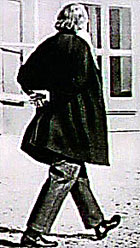
But living just for this one obsession isn't healthy, nor is it sustainable.  That's what the other little obsessions are about.  I tend to burn out or reach a place where I can't go any further until my mind settles down.  I need things that are relaxing enough to get back on track...which is hard for someone who's as addicted to study as I am.  Hence the more physical activities--particularly a good long walk. There are scads of studies that point to taking a walk as being facilitating to creativity, and scads of artists and thinkers who followed the same formula...including my beloved Brahms...

So I believe that when one is so obsessed that one begins seeing things in relation to other things in a completely and bizarrely different way...overlaying to the extent that there is no separation in the representation of those things...truly productive creativity can occur.  It's no longer random, and the mind automatically filters through arbitrary connections.  We remember things that stand out to us as remarkable.  The stronger the connections are, the more we remember them and can work off of them.

 Where is all this going?  Just back to my original hypothesis: Creativity is crossbreeding obsessions, and this encompasses an entire subset of prerequisites to enable the right way to obsess.  Which, I assume, is a life-long pursuit in and of itself.

What do you think?  How do you get and keep yourself in a mental space to be creative?  Have you found any of these principles for work for you?  Let me know in the comments below and I'll be eternally grateful!

Thursday, April 23, 2015

Sebastian Currier, composer


Last Tuesday at the Symphony, I had the privilege of attending a Q&A with composer Sebastian Currier, whose new composition commemorating the 100th anniversary of the beginning of World War I, 'Divisions', will be having its world premiere with the Seattle Symphony this evening at Benaroya Hall.

Currier, who was raised in Providence, RI and graduated with a DMA from the Julliard School of Music, composes primarily for ensembles and orchestra.  In his young-adulthood, he self-reportedly haunted the convenience store for new records until they began collecting new releases specifically for him.  He began listening to rock music with his brother, composer Nathan Currier, and gradually fell in love with the LPs of orchestral music that his father enjoyed, as the music had infinite possibilities of 'travel'.

His personality is very funny and down-to-earth; as he and SSO associate conductor Stilian Kirov took their seats for the Q&A, they engaged in quick-fire banter which made it somewhat unclear exactly who was supposed to be asking the questions.

What is 'Divisions'?  According to Currier, it represents a large variety of topics related to the WWI theme.  In addition to the battalion divisions in the war and the obvious divisions between nations, it also represents a music form from the 16th century known as 'divisions' in which the music begins slowly and divides and subdivides into smaller and smaller divisions of the beat; a classic example of this is J.S. Bach's 'Passacaglia'.  However, Currier takes this idea in reverse; his ideas start very fragmented and become more cohesive as the piece progresses.

There is much dialogue and instrumental depth in his works.  'Microsynth', which, as its name implies, is a miniature symphony, utilizes vibrant, spinning sounds, voices quickly passing with highlights in all sections, not simply strings or winds.  Many characters share a dialogue that, unlike Ives, do not seek to compete with each other, merely banter, like his introduction with Kirov.  Everything gets its chance to speak, and rather than being interrupted, the thought is taken over without pause and passed around.

Perhaps the most useful word I can think of to describe the effect his music has on me is 'collective'.  There is much melodic and harmonic richness, but to set his voice apart from the Romantics, he utilizes a faster pace of exchange.  The notes, the idea, the theme itself is cohesive, regardless of who or what is playing it.  With no overlap, they flit from timbre to timbre and yet remain pure.  This is a strong departure from the Romantic norm, in which melodies typically conclude with the instrument they began with, and then another instrument picks up the idea and answers back.

Favorite pieces that I have heard so far include:

Verge for Clarinet, Violin and Piano
Time Machines (dedicated to Anne-Sophie Mutter)
Next Atlantis (utilizing conversation between electronic effects and the symphony)

I'd recommend Currier's compositions for people who value complexity and have a moderate to advanced understanding of orchestral music.  The sound can be nearly overwhelming at times, but this effect is enhanced by a knowledge of instruments and their relationship to the score.

Visit Sebastian Currier's website

Sunday, April 19, 2015

SSO: Schnittke Violin Concerto no. 4 and Shostakovich Leningrad Symphony

In general, when I invite friends to come with me to the Symphony, I try to start them out with something a little more mainstream: some cheerful Mozart, memorable Beethoven or romantic Rachmaninoff.  Yet, for some reason I decided to invite a group to come with me tonight to the somewhat jarring combination of Schnittke and Shostakovich.  It is fortunate for me, therefore, that this group of friends actually enjoyed their night with me, rather than sending them fleeing from 20th century classical music forever.

It must be admitted that the first time I heard the Shostakovich Leningrad Symphony quoted, it was in an anime called "The Melancholy of Haruhi Suzumiya" as the background midi music for a game called "Day of Sagittarius III".  Like with another fantastic quote of Mahler Symphony 5 mvt 3 at the end of the series, I found myself hearing the full version considerably later and nodding appreciation at the music director's taste.

On a more professional note, I had also attended a presentation at Benaroya Hall by second violin member Stephen Bryant, who had the luck of being "twelfth man" -- quite literally as the twelfth chair second violinist who performed a magnificent counter-solo to Alexander Velinzon's center stage solo.  Bryant opened his talk by explaining that the "most magnificent, deepest piece of music in the orchestral repertoire" was the Schnittke Violin Concerto no. 4.  His description of a piece which I had never even heard of before intrigued me; and in the pre-concert lecture, this sensation was echoed by speaker Claudia R. Jensen: "The only word to describe this work is...'Fantastic'."  While this indeed is the first adjective that came to mind as I started to hear the actual thing, I think that for me a more specific description is the word "riveting".

Indeed, I sat through the concerto riveted.  The eclectic nature of the work alone, with its moody themes tossed back and forth with whip-lash speed between baroque, classical, and just plain "lots of minor seconds everywhere", with harpsichord, celeste, two sets of orchestral bells, prepared piano, and an active vibraphone section in the percussion, was enough to elicit a whole array of emotional reactions, from creepy chills to sporadic laughter.  The highly lyrical quality of the melody, a variant of the Westminster chime, anchored the attention of the ear amid the otherwise helter-skelter themes, harmonies and rhythms scattered in a decisively free-form structure (one of my friends described it as "[Schnittke] has the Post-Modern philosophy of hiding the coolness of the piece in a bunch of noisy clutter".  Another would like me to quote her as saying "It sounds like driving a bus full of musicians through a wormhold.")  With impeccable timing, the music utilizes sweetness dragged into monotony for just long enough to tempt one to look at one's watch...and then quite suddenly dive into loud cacophony.   In all honesty, I must contrast this with the third and final movements of the Shostakovich, which did contain more length than the ear might desire.

One somewhat jarring effect of the concerto is the instruction for the violinist to perform a "cadenza visuale", in which Velinzon actually lifted the bow completely above the strings of his instrument and performed sweeping, exaggerated motions without even touching horsehair to catgut.  I'm not entirely sure how I feel about this instruction, although I think that if played quite seriously and not quite as blatantly, it might have a startling effect.


As for the Leningrad Symphony, its length is really the only complaint I have with it.  Otherwise I found myself rubbing the goosebumps on my arms the entire time.  The first movement is a staggering 20 minutes long in itself, but the transition from the beginning theme, a sturdy, placid theme of a sturdy, placid people, to the ominous off-stage snare drum, ushering in the famous march theme, repeated over and over to a terrifying climax, to the "battle" music, and ending back with the original theme, now faded and inglorious, is extraordinary, reminiscent of the buildup of Ravel's Bolero, yet more encompassing and certainly longer.  The second movement was pleasant; the third I have no fond memories of, and the fourth felt like something stretched out too long into a giant buildup, finishing with a "Lord of the Rings" climax...which is to say, a series of which continually felt like the end without actually being the end.

My reservations with its length notwithstanding, I must add the Leningrad Symphony has an impressive history, as Shostakovich was living in Leningrad when it was being besieged by Hitler's armies in 1941.  He completed three movements during the siege, while working as a fire fighter at the same time.  The symphony was smuggled across borders, through Casablanca to the States, where it received such a welcome as a patriotic masterpiece that it was performed over sixty times in the first year of its welcome in the US alone.  Whether its accolades are due to the integrity of the music, or to its sensational background, I think only time will tell.

Until next time, до свидания my friends...

Thursday, April 9, 2015

Performances at Wallingford Community Senior Center

Greetings!

This upcoming late spring/early summer, I'll be giving three performances at the Wallingford Community Senior Center:

http://wallingfordseniors.org/

The dates will be:

May 15th, Friday 11:30-1:00
June 6, Friday 11:30-1:00
June 19th, Friday 11:30-1:00

I'll be playing some soft popular music from the 40s-60s, open for requests and/or sing-alongs.

Cheers!

Thursday, March 5, 2015

Compositions CV

Compositions by G Wallis:

2000:
-Ode to Grandpa (voice and piano)

2001:
-Overwhelm Me (pop song)
-A Simple Song (piano)
-Waltz in Eb (piano)

2002:
-Tuning Out (pop song)
-Shattered (pop song)
-Pearls (piano)

2003:
-Unspeakable Grace (pop song)
-You Can't (pop song)
-For Erin (piano)
-Anna, Dear (voice and piano)

2004:
-So Many Times (pop song)
-Lullaby, My Dear (voice and piano)
-Etude in 5/4 time (piano)
-Allan (piano)
-Into the West arrangement (piano, violin, two voices)

2005:
-Amazing (choir and piano, unfinished)
-3 Intermezzos (piano)
-Interlude (piano)
-5:29 am (piano)

2006:
-"With Feeling" (piano)
-Beauty Enthroned (piano)
-Dark Eyes (piano)
-L'arc En Ciel (violin and piano)
-Crater Lake (clarinet and harp)
-Winter Scene (flute, violin, cello, piano)
-Cannibal Fire (cello, oboe and trombone)

2007:
-PW (?) (piano)
-Romanzse (piano)
-Bluch Hurl (5 variations for piano)
-Grumpy Fugue (organ)

2008:
-From 'Maud' (voice and piano)
-Interlude (flute and bass)
-On 'Spring' (voice and piano)

2009:
-Wandering Waltz (piano)
-Orchestral arrangement of Grieg's 'The Butterfly'
-'Leisurely' (piano)
-'Pacato' (piano, duduk, cello)
-'Adagio' (piano)
-'Allegro/Vivace' (piano)

2010:
-Yes! The Young Sparrows (voice and piano)
-Loved One's Fan (voice and piano)
-'Lento' (piano)
-Four Seasonal Haiku (voice and piano)
-A Route of Evanescence (voice and piano)
-I Wish that it would Rain (voice and piano)

(2011-2012 nothing)

2013:
-Fifteen Inventions and Fugues (piano)
-Morning Ditty (piano)
-Ae Fond Kiss (voice and piano)
-Mauchlin Belles (voice and piano)
-Winter (voice and piano)
-No Worst, there is None (voice and piano)

2014:
-Deep (voice and piano)
-Facebook (pop song)
-Violin Sonatina (violin and piano)
-Tristesse (piano)
-Zetsubou kara Kibou he (piano)
-Spanish Flurry (piano)
-Tam O'Shanter (choir)
-Snow (choir)
-1 Corinth. 13 (choir)
-The Master (orchestral cue)
-Achil's Challenge:
   -Einsam (piano)
   -Cho-Cho Chan (piano)
   -Ame no Te ga Semutai (piano)
   -Hi no Ki (piano)
-Quietly Crying (piano)
-Five Little Dances (piano)
-Ditty for Erika (piano)

2015:
-The Faceless Doll (poem background piano)
-The King of Ylys (voice, harp, guitar, recorder, percussion)
-The King of Ylys (choir)
-Drinking Under the Moon (choir)
-Insecurity (pop song)
-Candle (pop song)
-Lullaby for Amelia (classical guitar)

2016:
-Pie Jesu (choir)
-Loop Experimental Track 1 (electronic)
-Orchestration Experiment 2 (orchestra)
-Salton Sea (orchestra, choir, synth)
-Synth Shit 1.1, 1.2, 1.3
-Synth Shit 2.1, 2.2, 2.3
-Synth Shit 3.1, 3.2
-In the Village Plaza (harp, flute, strings)
-Theme Suite Variation no. 1 (orchestra)
-Theme Suite Variation no. 2 (pop song)
-Theme Suite Variation no. 3 (solo piano)

2017:
-Bloodstones (piano and poem)
-Bees and Butterflies (violin duet)
-Con Sordino (violin duet)
-Bloodstones (string quartet)
-End theme for Jackie Poon video (marimba, shaker and strings)
-Soundtrack for "Retreat" (48 hour film festival) - 16 tracks for full orchestra
-Enigma Demos 1 & 2 (MIDI)
-Soundscape (original recordings by the composer)
-Soundtrack for "Murder Moon" (48 hour horror film festival) - 10 tracks for synths, choir, and orchestra
-Soundtrack for "Lean on Me" (40 minute independent film directed by David Fowler) - 10 tracks for strings, winds, brass, jazz band, 8-bit instruments, piano, solo voice and solo cello

2018:
-Good Friend (piano, clarinet, cello)
-For String Ensemble
-The Elephant and the Clown (wind sextet)
-Sonata for Piano Duet (3 mvts)
-Soundtrack for "Speed Date" (48 Hour Film Festival) - 10 tracks for full orchestra
-Soundtrack for "Mara" (48 Hour Horror film festival) - 10 tracks for synthesizer
-Soundtrack for "The New James Richards Book" (20 minute independent film directed by Bilal Young) - 7 tracks for synthesizer

2019:
-Soundtrack for "Before I Go", (15 minute independent film directed by Ruchi Loomba) for piano, harp and strings


Friday, February 6, 2015

Seattle Symphony, Jan 29th, Charles Ives' Fourth Symphony


As the concert ended, half of the audience leapt to their feet in an applause that lasted ten minutes, as Ludovic Morlot, beaming, came back onto stage for another bow, and the orchestra stood, victorious.  The other half of the audience could be found streaming out the front doors as fast as they could, shaking their heads and grimacing.

At the "ask the artist" talk afterwards in the main lobby of Benaroya Hall, Morlot was asked, "Why did you choose to bill both Rachmaninoff's 3rd Piano Concerto and Charles Ive's Symphony 4 for the same concert?"  Morlot's answer was to the point: "Because I wanted you all to come!"

That impulsive billing decision succeeded in spades.  The next evening of the program, the house was completely sold-out, turning away dejected would-be audience at the box office.  I, being the unlucky usher that night who had to choose between the two above-mentioned magnificent pieces of art, went in for the second half, and got an earful of Ives.

To my utter surprise, I didn't hate it.  Actually, I can honestly say that the work appealed to my aesthetic values.

The entire work is a bipolar conglomeration of exceptional beauty and utter chaos.  Such chaos, in fact, that there has been a survival guide written for the orchestra by Thomas M. Brodhead.  It might also be mentioned, in passing, that although the work was completed in 1916, it was not performed until 1965.

Ives, who had a day job as a insurance salesman, has been called the "first American composer"--not by dint of nationality alone, but because he was the first to bring truly American elements of folk music together into formal composition.  This piece is littered with fragments of multiple folk songs, hymns, and American cultural phenomenon, often in blatant disregard of the others that happen to be playing at the same time.  In addition, the eerie timing of the work, on the crux of World War I, adds a chill to the otherwise innocently 20th century context.

A word must also be said about the orchestration of this piece.  In addition to the normal 20th century orchestral spread, an extra flute/piccolo has been added, more clarinets and bassoons than necessary, not one but three saxophones, two extra trumpets and a couple of cornets, 8 percussionists, two harps, and five keyboards, including two concert pianos, one for solo, one for four-hands, a celesta, an organ, and the obligatory upright piano--with random keys tuned at quarter tones.  Not to mention the chorus, of course, since their entrance is marked "preferably without chorus" (they sing anyway).  And to keep all this mess together, especially taking into account that there are two groups of instruments on opposite sides off-stage, Morlot decided to use four conductors, adding in a snarky aside to the audience in his introduction of the piece that as a result, there was a surplus of ego on stage as well.

So, what is it about this symphony that makes it actually enjoyable for some (albeit, hardly for everyone...)?  I believe it comes down to the craftsmanship that was poured into it.  As delicately balanced as Damocles sword, all of the melodic/harmonic elements, the pacing from climax to climax and beauty to chaos, and of course the orchestration, have been skillfully placed exactly where they have their greatest impact.  Nothing about it is haphazard or lazy.  It strings itself out, piece by piece, delivering the story without giving anything away.


The first movement begins by building an atmosphere that sounds like a quotation from every horror film ever made; with heavy piano and dark strings, and then a ghostly choir enters, singing a gentle hymn, in blissful unawareness of the harmonic significance of the rest of the orchestra.

The scherzo of a second movement, the 'comedy', spends its time dallying between slow, ghostly and at times hauntingly beautiful stretches of strings, the concert piano and light winds, interrupted with patches of brass, percussion, and many more pianos.  Thus, a series of climaxes lead up to a particularly poignant conclusion, as a solo violin plays its melancholy tune, and then four separate marching bands abruptly charge onto the scene, bombast the audience, and then collapse into silence.

A melancholy fugue based on a Christmas hymn, beginning in the celli, ushers in the third movement, lovely and actually tonal.  Almost completely scored for the strings, the movement also demands an organ, gloriously fulfilled at Benaroya Hall.

The final movement has more of the character of the second movement, with similar pendulum swinging through chaos and climax, yet it quotes the first and third movements as well, and closes with the choir, hauntingly beckoning in thoughts of the impending War.

I don't know if I will ever have a chance to hear this work again, but I can honestly say that I think the production put on by Morlot and the Seattle Symphony was outstanding.  The members of the orchestra seemed to be energized by the challenge of the music and exhilarated by the sound.  Their passion rolled over us, the audience, like a wave, drawing us into the dark world of Ives.

To be honest, I personally feel like this is the best performance I've experienced yet.

But we shall just have to wait for the Brahms Symphony 1 in June!

The Gardens Between

Imagine a game in which you can't actually control the characters you are playing - you can only move forwards and backwards in time...